

Composers > Selga Mence
Selga Mence
"I am proud that I am a Latvian composer, since we have an incalculable wealth Latvian folk songs, whose melodic intonations and substantive imagery is an inexhaustible fountain for works in many different compositional techniques."
Selga Mence
BIOGRAPHY
Selga Mence was born on January 12th, 1953 in Liepāja. Her father math teacher Jānis Mencis. In his youth, he studied choir conducting at the Jēkabs Vītoliņš Education Institute of Riga. Her brother Jānis Mencis Jr. is also a mathematician. Selga Mence graduated the 5th High School of Liepāja, with a focus on German (gold medal, 1971), after two years she was at the Emīls Melngailis Music College of Liepāja, then the composition class at the Latvian State Conservatory and studies with Pauls Dambis (1978, 1988). She has studied musicology. She worked for many years at the Latvian Culture Ministry Repertoire Editorial Council (19801987). In the 80s, she managed the childrens music sphere in the Composers Union. As of 1985, she is a lecturer and associate professor in the Latvian Academy of Music composition department.
Selga Mences name was first highlighted in association with choir music. Her works were performed at the Scandinavian Song Festival in Norway in 2000 and at many Song Festivals in Latvia, the United States, and Canada. Many Latvian choirs have achieved victory at international competitions with her works.
Selga Mence has participated in such projects as the Songbridge 2000 festival Europa Cantat XIV in Nevers, France, and at the Month of European Music in 2001, Basel. Her cycle Dziesmas (Songs) for two pianos was included in the top ten recommended works at the 1999 International Rostrum of Composers in Paris.
Choir songs, childrens music in these genres of creative work Selga Mences bright emotionality has been especially expressed, as well as the liveliness of musical images, love of Latvian folk verses with the traditional, stable world of value. Often using Latvian (and Liv) folk melodies and texts (often blurring the boundary between folksong arrangement and original music) altogether included in the national romantic tradition that still is developed with contemporary compositional materials. The works display sonoric colouristic possibilities and aleatoric characteristically improvisational games. Of highest importance is the intonative material that, determinedly and logically Selga Mences characteristic qualities directs, sets alight the works overall perception. Guntars Pupa correctly wrote, that she, as one of the first of the new composers, actualised melody in Latvian music in the 80s. (Literatūra un Māksla, 1986). It is possible that, due to this creative influence, the song genre has become significant in her newest instrumental writings, in a symbolic way concentrating within herself a very nuanced poetic character.
DISCOGRAPHY
CDs
Mārtiņa dziesma (Martins Song) (folk words) 212 / Jāzeps Mediņš Music College of Riga Mixed Choir, Conductor Jānis Lindenbergs. Recorded at the Riga Sound Recording Studio // Jāzepa Mediņa Rigas Mūzikas koledžas jauktais koris 1995, RS 003
Kur tu biji, bāleliņi? (Where were you, my brother? [Where Were You, Brother]) / Text Agris Pilsums / Female Choir Dzintars, Aivars Kalējs (piano), Conductor Ausma Derkēvica 353 / Balta gāja sērdienīte (In white Walked an Orphan [The White Orphan Girl Walked]) / Latvian folk song arrangement / Female Choir Dzintars, Conductor Ausma Derkēvica 503// Female Choir Dzintars 1995, Riga Recording Studio, RS 004
Lēni, lēni Dieviņš brauca (Slowly, Slowly Dievins Came) / Latvian folk song arrangement / Riga Dome Boys Choir, Conductor Jānis Erenštreits 353// Rīgas Doma zēnu koris dzied latviešu mūziku. Riga Dome Boys Choir Sings Latvian Music 1996, Rīgas Doma zēnu koris, BAF, 9612
Vēl zvana (Still Ding-Donging [Still Ringing]), cycle / Text Vizma Belševica, Agris Pilsums: Zvana vārdi. Kurzeme (Bells Words. Kurzeme) 321; Zemes vidus zvans. Vidzeme (Bells at the Centre of the Earth. Vidzeme) 330; Vēja zvans. Zemgale (Winds Bell. Zemgale) 336; Ezera zvans. Latgale (Lakes Bell. Latgale) 310; Vējrāžu zvans. Rīga (Weather vanes Bell. Riga) 229 / Female choir Dzintars, Conductors Ausma Derkēvica, Pēteris Plūme // Female choir Dzintars [1996/97], RS 022
Neba maize pate nāca (No Bread Came By Itself ) (dainu vārdi) 152 / Chamber Choir Skali, Conductor Gunta Paškovska // Mūzai. XXII Vispārējo Latviešu Dziesmu svētku dziesmas dzied labākie Latvijas kori 1998, ADF 001
Kontrasti (Contrasts) for flute and cello / Pia Kaufmanas, flute and Ingera Guldbrandt Jensen, cello. Recorded at the Dyssegård Church, Denmark, 1999 539 // Wärme-Quartet Mater Mea. New Baltic and Nordic Chamber Music Danacord 2000, DACOCD 532, Digital
Mārtiņu dziesma (Martins Song) (words from Latvian folk texts) 223 / Riga Dome Cathedral Boys Choir, Conductor Mārtiņš Klišāns // Rīgas vaiņags. Sung by the Riga Dome Cathedral Boys Choir, Conductor Mārtiņš Klišāns 2001
No tālienes es pazinu (I Recognized From Afar) 224; Aiz Daugavas augsti kalni (Beyond the Daugava are Tall Hills) 300; Neba maize pate nāca (No Bread Came By Itself) 215; Balta gāja sērdienīte (The Orphan Girl Walked [The White Orphan Girl Walked]) 529 / The Chamber Choir Ave Sol, Conductor Imants Kokars // Anthology of Latvian Choir Songs IX. 19661990. Sidrabiņa lietiņš lija. Folksong arrangements 2001, Ave Sol, LR-0101
Saule pina vainadziņu (The Sun's Golden Wreath) 820; Laima gāja pār pagalmu (Laima's Blessing) 420; Ik rītiņu kumeliņi (My Beloved Steed) 520 / The Chamber Choir Ave Sol, Conductor Imants Kokars // Anthology of Latvian Choir Songs X. 19912000. Saule pina vainadziņu. Folksong arrangements 2002, Ave Sol, LR 0202
Interferences: Vēja atmošanās (Awakening of the Wind) (Māris Rungulis) 437; Sommerregen (Summer Rain, Hermann Hesse) 312; Abendwolke (Evening Cloud, Konrad Ferdinand Meyer) 317; Salve ([South and North], Jānis Rainis) 303; Der Gesang des Meeres (Song of the Sea, Konrad Ferdinand Meyer) 238; Skan stabule (The Reed Pipe Sounds) (Knuts Skujenieks) 438; Rotaļa (Game) (Jānis Rainis) 155 / Basel Girls Choir (Conductor Mihael Schaub) and the Riga Dome Cathedral Boys Choir (Conductor Mārtiņš Klišāns) / [Latvian folksong arrangements and original songs with texts from Latvian folk verses] Pavasara rotāšana (Spring Games) 224; Mārtiņa dziesma (Martins Song) 221; Ziemas saulgrieži (Winter Solstice) 324; Jāņi (Midsummer) 343; Gara, gara šī naksniņa (Long, Long is this Night) 251; Skaista, balta viešņa gāja (A Beautiful, White Lady Guest Went) 414; Ik rītiņu sīkas rikšas (The Daily Light Trots) 446 / Riga Dome Cathedral Boys Choir, Conductor Mārtiņš Klišāns // Selga Mence. Interferences. Die Interferenzen RS 2002
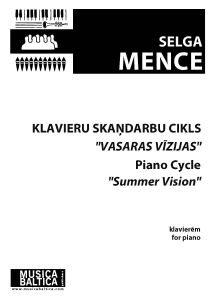
Dziesmas divām klavierēm (Songs for Two Pianos) / Antra and Normunds Vīksne, piano duo. 1753// Latvian music series, volume 1: Antra and Normunds Vīksne, piano duo 2003, Angelok 1, CD 7701
Balta gāja sērdienīte (A White Orphan Girl Walked) (Latvian folk song arrangement) 506 / The Chamber Choir Ave Sol, conductor Imants Kokars // Baltic Choral Works I. A Collection of Latvian Choral Works 2003, VICS-61107
Livonia. Carmen voluptatis et doloris / Soloists Ieva Ezeriete, Inga Martinsone, Gundega Krūmiņa, Gundars Dziļums, the ensemble Hortus Musicus, soloists Andress Mustonens (violin), Olevs Ainomee (oboe), Latvian Radio Choir, conductor Sigvards Kļava // Livonia 2007, Latvian Radio, LRCD048
Impressions of Salvador Dali for piano 602 / Diāna Baibusa-Zandberga // Dreams of Spain 2011, Diāna Zandberga, [s.n.]
Neba maize pate nāca (Bread does not come for naught [No Bread Came By Itself]) (Latvian folk verses) 156 / Kamēr..., Conductor Māris Sirmais // Kamēr... Riga Youth Choir [s. a.], Platforma Records, PRCD 016
Records
Cycle Pa latvju dainu lappusēm (Through the Pages of Latvian Folk Verses) (Latvian folksong words): No tālienes es pazinu (I Recognized From Afar); Aiz Daugavas augsti kalni (Beyond the Daugava are Tall Hills); Neba maize pate nāca (No Bread Came By Itself) 817 / Peoples Youth Choir Zvani, Conductor Jānis Garančs // Jauniešu Tautas koris Zvani 1987, Melodija, C10-26317-000
Dziedat, meitas, vakarā (Sing, Girls, in the Evening), Ko gaidīji, sērdienīte (What Were You Waiting For, Orphan Girl); Skalojos, velējos (I Washed, I Dollied); Kur tu jāsi, kalpa puisi (Where Do You Ride to, Servant Boy); Dziedat, meitas, nu iet koši (Sing, Girls, Now it is Brilliant) (Arrangement of Latvian folksongs) 616 / Peoples Choir Ausma, Conductor Jānis Zirnis / Kur tu biji, bāleliņi? (Where Were You, Brother?) (Agris Pilsums) 352 / Peoples Choir Rūta, Conductor Terēze Broka // XX Vispārējie Latvian Dziesmu svētki. Mana dziesma II 1990, Melodija, C10-30355 008
LITERATURE
I. Lūsiņa, Pirmā autorkoncerta ieskaņā (In the Sound of the First Author Concert) // Padomju Jaunatne, May 8th, 1980 L. Ašme, Mūzika visapkārt. Kur Tava? (Music is Everywhere. Where is Yours?) [discussions with the composer] // Skola un Ģimene, 1986, no. 3, 2425 G. Pupa, Visas manas greznas dziesmas (All My Magnificent Songs) // Literatūra un Māksla, May 23rd, 1986 [G. P.], Selga Mence // Liesma, 1986, no. 8, [1112] I. Kārkliņa, Vēlāk vasara pārtaps notīs (Later the Summer will Melt into Notes) [discussions with the composer] // Sieviete, 1993, no. 10, 34; I. Imbovica, Divi pirmatskaņojumi (Two Premieres) [Symphonic music concert in Liepāja. Selga Mences works, conductor I. Kociņš] // Kurzemes Vārds, February 22nd, 1994 I. Lūsiņa, Neba Selga pate brauca (No Selga Went By Herself) // Diena, July 16th, 1999 [I. L.], Jubileja bez autorkoncerta (Anniversary Without an Author Concert) // Diena, January 11th, 2003 A. Hilo, Latviešu komponistu skaņdarbi bērniem (Works for Children by Latvian Composers) [Diploma Thesis]. Riga: Latvian Academy of Music, 2003 M. Rubeze, Livonia. Carmen voluptatis et doloris [about the premiere of the work at the festival Arēna] // Mūzikas Saule, 2005, No. 6
Lolita Fūrmane, supplemented by Mārīte Dombrovska
Photo - Edmunds Mickus
© LMIC